

Microfiber fabric is usually made from polyester, polyamide, or both. In consumer products, the polyamide component is generally nylon. Many microfiber bedding fabrics are 100% polyester, while cleaning cloths and some personal-care textiles use polyester-polyamide blends.
The word “microfiber” describes the fineness of the individual fibers. It does not identify one fixed material, blend ratio, weave, or quality level.
Two fabrics can carry the same microfiber label but feel and perform very differently. Their final properties depend on the polymer, filament structure, fabric construction, and finishing process.
Microfiber Describes Fiber Size, Not One Material
Microfiber is a fiber-size category rather than a specific raw material. Polyester, polyamide, polypropylene, and some other manufactured fibers can all be produced at microfiber dimensions.
AATCC microfiber terminology defines microfiber as a fiber with a linear density below one denier or one dtex.
Denier measures linear density. One denier means that 9,000 meters of fiber weigh one gram. It does not directly measure fiber diameter.
When polymers and cross-sectional shapes are similar, a lower denier generally means a finer fiber. Different material densities or fiber shapes can still produce different diameters at the same denier.
Finer filaments increase fiber count and surface area within the fabric. This can support smoothness, dense coverage, small capillary spaces, and closer contact with liquid or particles.
These benefits are not automatic. Softness, liquid handling, durability, and linting also depend on split status, fabric construction, pile, GSM, and finishing.
Key distinction: Microfiber describes how fine a fiber is. It does not reveal the complete material composition, fabric structure, finish, or product quality.

What Materials Are Used to Make Microfiber Fabric?
Most consumer microfiber fabric is made from polyester, polyamide, or both. Because these are synthetic polymers, most consumer microfiber is plastic-based.
However, microfiber still describes fiber fineness rather than one chemical material. Polymer type provides the starting properties, but it cannot predict the performance of the finished fabric by itself.
Polyester
Polyester is the most common material in microfiber bedding, apparel, upholstery, and many household textiles. It offers useful strength, dimensional stability, abrasion resistance, and scalable production.
Polyester has low moisture regain, which means the polymer absorbs little moisture into its internal structure. A polyester microfiber fabric can still pick up and move liquid through its fine filaments, capillary spaces, surface pile, and finishing.
For this reason, “the fiber absorbs water” and “the fabric picks up water” are not interchangeable claims.
Many bedding fabrics use 100% polyester microfiber. The filaments may be woven or knitted into a dense fabric and then brushed to produce a smoother, softer surface.
For a practical example of how these variables appear in a commercial specification, Joyilife’s polyester microfiber fabric range includes different weights, widths, finishes, colors, and customization options for sheets, duvet covers, pillowcases, and comforter shells.
Polyamide, Including Nylon
Polyamide is a family of polymers. In consumer microfiber products, the polyamide component is commonly nylon 6 or nylon 6,6.
Polyamide generally has greater moisture affinity than polyester. It can contribute flexibility, wetting, and liquid retention, especially when used as part of a well-designed bicomponent filament.
Polyester and polyamide are frequently combined in splittable microfiber. Common commercial ratios include 80% polyester and 20% polyamide or 70% polyester and 30% polyamide.
These ratios describe fiber content, not quality grades.
A higher polyamide percentage does not automatically produce a softer, more absorbent, or more durable fabric. A well-made 100% polyester fabric can be more suitable for a particular product than a poorly constructed polyester-polyamide blend.
Other Materials and Feedstocks
Polypropylene microfiber is used in selected wipes, filters, medical textiles, and industrial applications. Some technical products also use ultrafine manufactured cellulosic or specialty polymer fibers, although these are less common in general consumer products sold simply as “microfiber.”
Recycled polyester is not a separate polymer category. It describes the source of the polyester feedstock.
Using recycled feedstock can reduce demand for some virgin material, but it does not prove that the finished fabric sheds fewer fibers, lasts longer, feels softer, or performs better. Buyers comparing material sources should evaluate traceability and performance separately, as explained in this recycled vs virgin polyester fabric guide.

How Is Microfiber Fabric Made?
There is no single microfiber manufacturing process. Some filaments are spun directly at a very fine size. Others begin as bicomponent fibers and are separated into smaller filaments during later processing.
The selected route depends on the required fineness, surface structure, performance, production cost, and final application.
1. Polymer Preparation and Spinning
Synthetic microfiber production commonly begins with polymer chips or pellets. The material is dried to control moisture and then melted under conditions suited to that polymer.
The molten polymer is pushed through a spinneret containing small openings. The emerging streams form continuous filaments, which are cooled and solidified.
The filaments are then drawn. This stretches and aligns their polymer structure, helping control strength and final linear density.
Some filaments are also textured to add bulk, softness, stretch, or a different surface character.
2. Direct-Spun Microfiber
In direct spinning, a single polymer is extruded into filaments that are already fine enough to qualify as microfiber.
These single-component filaments do not require a later splitting stage. They can be grouped into yarns and then woven or knitted into fabric.
Direct-spun polyester microfiber is commonly used for smooth or brushed textiles such as bedding, apparel, linings, and selected household fabrics.
Not every microfiber is therefore a split fiber.

3. Segmented-Pie Microfiber
Segmented-pie microfiber is a bicomponent structure. Two polymers are extruded together inside one filament, with the cross-section divided into alternating wedge-shaped segments.
Polyester and polyamide 6 are a common combination. The segments can later be separated through hydroentanglement or another suitable mechanical process, creating multiple finer filaments from the original fiber.
Research on PET and nylon 6 segmented-pie microfiber nonwovens provides a practical example of this bicomponent, spunbond, and hydro-entangled construction.
Segmented-pie fibers are used in cleaning cloths, wipes, mops, synthetic leather bases, and some personal-care textiles. They should not be presented as the standard construction for every microfiber product.
4. Islands-in-the-Sea Microfiber
An islands-in-the-sea filament contains many small “island” components inside a surrounding “sea” matrix.
After spinning, the surrounding matrix is removed through a process designed for the selected polymer combination. The remaining islands become bundles of extremely fine filaments.
This route can produce filaments that would be difficult to handle through direct spinning alone. It is used in synthetic suede, microfiber nonwovens, filtration media, and other technical textiles.
Because the surrounding matrix may be removed, the original spinning recipe is not necessarily the same as the final fiber composition.
5. Fabric Formation and Finishing
Once the filaments or yarns are ready, they can be made into woven, knitted, or nonwoven materials.
Woven fabrics generally provide good dimensional stability. Knitted structures can offer softness, stretch, and a fuller surface. Nonwovens can be engineered for wipes, filters, synthetic leather bases, and technical products.
The material may then be dyed, heat-set, brushed, raised, embossed, softened, or given a functional finish.
Finishing can change the initial hand feel, surface appearance, and wetting behavior. A very soft new sample may owe part of its feel to brushing or softening agents rather than fiber composition alone.
For bedding development, comparing brushed and washed microfiber can help buyers understand how two finishing routes change surface texture, warmth, drape, wash behavior, and product positioning.
Claims such as antimicrobial, stain-resistant, hydrophilic, or low-odor should be supported by suitable test methods. They should not be assumed from the word “microfiber.”

What Determines Microfiber Performance?
Microfiber performance comes from four connected layers. Fiber percentages describe only one part of the finished material.
| Performance layer | What to examine | Why it matters |
|---|---|---|
| Polymer | Polyester, polyamide, polypropylene, or another material | Sets the starting strength, moisture affinity, heat response, and dyeing behavior |
| Filament geometry | Linear density, diameter, cross-section, and split status | Changes surface area, flexibility, capillary spaces, and surface contact |
| Fabric construction | Woven, knitted, or nonwoven structure, pile, density, and GSM | Controls thickness, softness, porosity, stability, and drying behavior |
| Finishing | Brushing, heat setting, softening, and functional treatments | Can change hand feel, appearance, wetting, and early-use performance |
An 80/20 label describes only polymer percentages. It does not reveal filament denier, cross-sectional shape, splitting efficiency, pile density, knitting quality, finishing, linting, or wash durability.
This explains why two fabrics with the same composition can behave very differently.
Why Absorbency Is Not One Simple Property
“Absorbent” is often used as a general marketing word, but it can refer to several different fabric behaviors:
- Moisture regain: Moisture absorbed into the fiber from the surrounding air.
- Wetting: How easily liquid spreads across the fabric surface.
- Wicking: How liquid moves through spaces between fibers.
- Liquid pickup: How much liquid the fabric removes from another surface.
- Liquid retention: How much liquid remains within the fabric after pickup.
- Drying speed: How quickly retained moisture leaves the fabric.
A polyester microfiber may have low moisture regain but still achieve useful liquid pickup and wicking through its fine filaments, capillary spaces, surface pile, and finish.
A fabric can also pick up liquid quickly and dry faster than a heavier product. Pickup and drying measure different stages, so these properties are not contradictory.
GSM must also be interpreted carefully. A higher-GSM fabric contains more material per square meter, but this does not automatically mean better cleaning, greater softness, faster drying, or longer life.
Claims such as “absorbs seven times its weight” or “absorbs more than cotton” are incomplete unless they identify the exact product, test method, and test conditions.

How to Evaluate and Choose Microfiber Fabric
The right microfiber specification begins with the final product. Bedding, cleaning towels, facial cloths, upholstery, wipes, and filters require different surface structures and performance tests.
Read Beyond the Microfiber Label
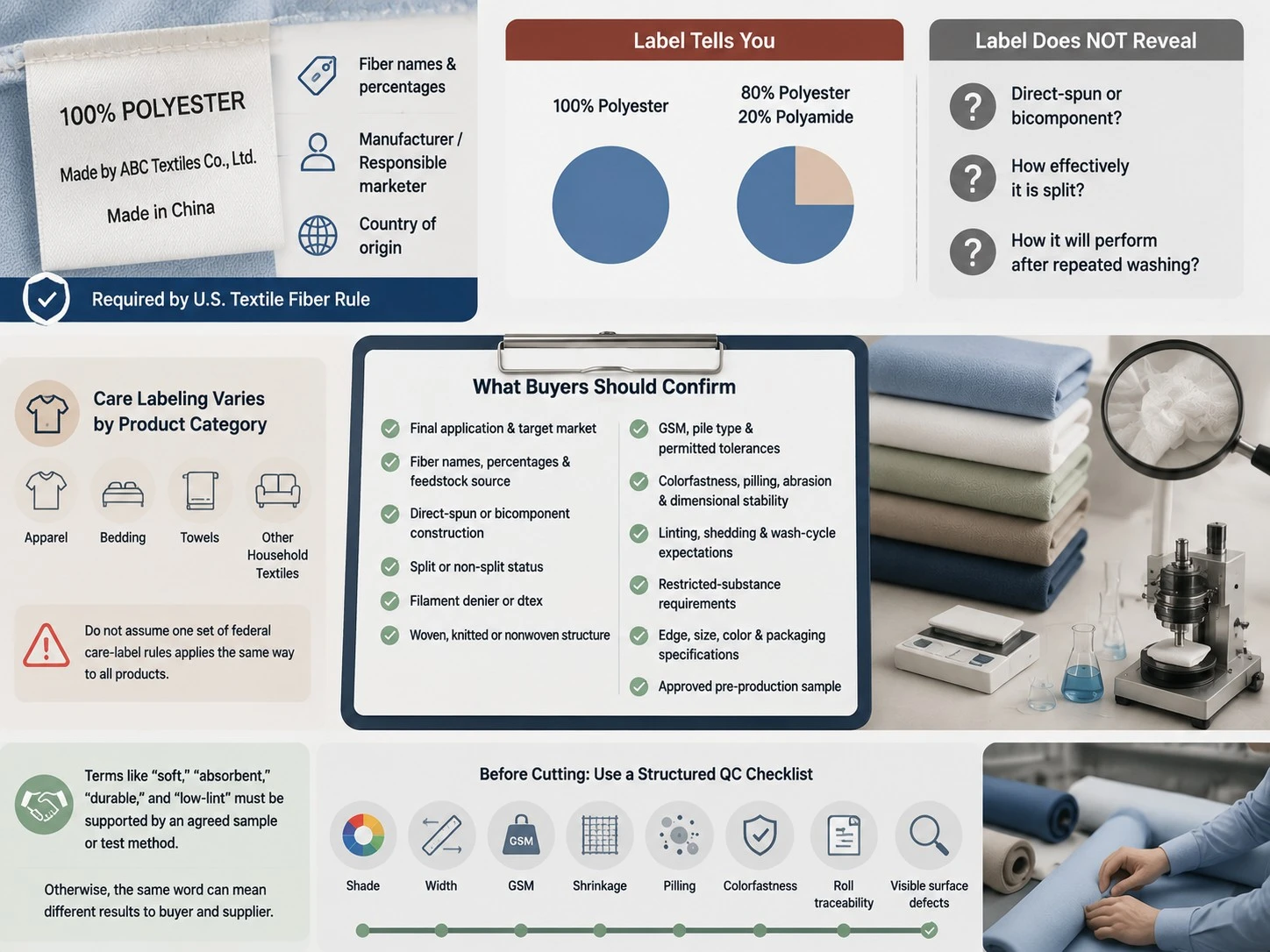
For products covered by the U.S. Textile Fiber Products Identification Act and Textile Fiber Rule, the label generally must disclose the generic fiber names and percentages by weight, the manufacturer or responsible marketer, and the country where the product was processed or manufactured.
A label may tell you that a product is 100% polyester or 80% polyester and 20% polyamide. It normally does not reveal whether the fiber is direct-spun or bicomponent, how effectively it has been split, or how the fabric will perform after repeated washing.
Care labeling is a separate issue and depends on the product category. Buyers should not assume that one set of federal care-label rules applies in the same way to apparel, bedding, towels, and every other household textile.
For product development or bulk purchasing, confirm:
- final application and target market;
- fiber names, percentages, and feedstock source;
- direct-spun or bicomponent construction;
- split or non-split status;
- filament denier or dtex;
- woven, knitted, or nonwoven structure;
- GSM, pile type, and permitted tolerances;
- colorfastness, pilling, abrasion, and dimensional stability;
- linting, shedding, and wash-cycle expectations;
- restricted-substance requirements;
- edge, size, color, and packaging specifications;
- an approved pre-production sample.
Terms such as “soft,” “absorbent,” “durable,” and “low-lint” should be tied to an agreed sample or test method. Otherwise, a buyer and supplier may use the same word while expecting different results.
Before fabric enters cutting, a structured microfiber fabric QC checklist can help control shade, width, GSM, shrinkage, pilling, colorfastness, roll traceability, and visible surface defects.
Match the Structure to the Application
The best microfiber is the one engineered for its intended use. The blend ratio should follow the product requirements rather than lead the decision.
| Application | Specifications that deserve priority | Common mistake |
|---|---|---|
| Bedding | Fineness, brushing, GSM, construction, pilling, airflow, and dimensional stability | Judging quality only by softness or thread count |
| Cleaning cloths | Split structure, surface pattern, liquid pickup, linting, and wash durability | Assuming all 80/20 cloths perform alike |
| Facial and makeup cloths | Smooth pile, covered edges, finish, colorfastness, and controlled friction | Treating “microfiber” as proof of skin gentleness |
| Upholstery | Abrasion resistance, backing, stain finish, and dimensional stability | Selecting only by fabric weight |
| Wipes and filters | Nonwoven formation, pore structure, strength, and fluid handling | Comparing them with knitted household cloths |
Use the table as a screening guide, then approve a washed sample.
For bedding, check whether brushing remains stable after laundering. For cleaning cloths, verify splitting instead of relying on composition alone. For facial cloths, assess wet-surface smoothness and edge construction rather than assuming a thicker or plusher cloth is gentler.
When evaluating bedding materials, use a consistent process to compare microfiber fabric samples by GSM, hand feel, usable width, shrinkage, pilling, shade, sewing behavior, wash stability, and sample-to-bulk consistency.
Consider Skin Contact and Environmental Claims Carefully
The microfiber label does not prove that a cloth is suitable for every skin type. Friction also depends on surface texture, edge construction, pressure, rubbing time, cleanliness, and detergent or softener residue.
A facial cloth should not be promoted as treating acne, shrinking pores, detoxifying skin, or replacing medical care. Product claims should remain limited to functions that can be demonstrated through the material, construction, instructions, and suitable testing.
For direct-skin-contact products, OEKO-TEX STANDARD 100 certification can provide evidence that the certified article has been tested for harmful substances. Product Class 1 covers products for babies and children up to age three, while Product Class 2 covers products with direct skin contact, including bed linens.
However, STANDARD 100 does not by itself prove softness, durability, washing performance, low shedding, biodegradability, or overall sustainability.
Environmental claims require the same caution. Fiber release can occur during manufacturing, use, laundering, and disposal. The 2024 U.S. interagency report on microfiber pollution discusses solutions across product design, manufacturing, filtration, use, reuse, and end-of-life management rather than treating consumer washing as the only source.
Recycled content may reduce virgin feedstock use, but it does not establish lower shedding or longer product life without product-specific evidence.

Build the Right Microfiber Fabric With Joyilife
Microfiber fabric is usually made from polyester, polyamide, or both, but composition is only the starting point. Filament fineness, cross-section, splitting, fabric construction, GSM, pile, finishing, and testing work together to determine how the finished material feels and performs.
Contact Joyilife to discuss your target application, composition, fabric structure, weight, surface, colors, finishes, testing, packaging, and sample requirements. Clear specifications and an approved sample can help align your OEM or ODM product before bulk production.
 English
 Russian
 Spanish
 Arabic
 French
 Korean
 German
 Portuguese
 Italian
 Turkish
 Vietnamese
